

Rain garden project helps with watershed restoration
May 3, 2012
Proving the idea of a rain garden isn’t limited to individuals, members of the Hazen Earth Service Corps in conjunction with the Friends of the Cedar River Watershed installed Renton’s first rain garden in 2010.
“The idea of a rain garden overall is that it’s manageable all on its own,” Service Corps co-president Maddie Martin said. “The first couple of years we’re just there to make sure it’s draining correctly and that it’s sustainable.”
A rain garden is a depressed planting bed that captures and slows storm water runoff, allowing it to seep into the garden soil while filtering mud and pollutants, such as motor oil and heavy metals, out of the water.
Friends of the Cedar River Watershed, a King County based nonprofit organization that encourages volunteerism through community groups and projects, helped launch the project to address storm water runoff by building rain gardens at Hazen High and other local schools and in the community.
Projects were conducted through the Friends of the Cedar River Watershed in five of the 12 school districts in the Cedar River and Lake Washington watershed.
PSE offers guidance on solar energy
May 3, 2012
Puget Sound Energy is providing contractor referrals to residential electric customers interested in installing home solar-electric photovoltaic systems
Bellevue-based PSE added 14 solar installers to the Contractor Alliance Network — a group of independent contractors prescreened by the utility to perform energy-related home improvement.
Customers interested in installing a solar-power system and in need of a contractor can receive estimates from contractors when they request a referral at www.pse.com or by calling 1-800-562-1482 toll free.
In addition to installing customers’ home solar-power systems, contractors can help customers prepare interconnection and production payment documents necessary to participate in PSE’s net metering program.
Overall, more than 1,000 PSE electric customers have had solar-power systems installed and connected to the grid — up from a little more than 500 such systems in early 2010. The total generating capacity from customer-owned solar-power systems is more than 5 megawatts, compared to 2 megawatts in early 2010.
Customers can receive a 30 percent federal tax credit and other financial incentives for installing a solar-power system.
The state provides another incentive, administered by PSE through Renewable Energy Advantage Program. The state incentive pays customers for every kilowatt of power produced by solar-power systems.
Gaining ground for the Puget Sound
May 3, 2012
12,000 Rain Gardens campaign aims to curb pollution, create beautiful landscapes
As more than 14 million pounds of toxins enter the Puget Sound each year, two Washington entities are working hard to curb the contamination — 12,000 times over.
The 12,000 Rain Gardens in Puget Sound project, spearheaded by Stewardship Partners and Washington State University, aims to grow and designate 12,000 rain gardens — which reduce pollution and alleviate flooding all while creating attractive landscapes that promote native plant growth in hearty soil — in the area by 2016.

By Stewardship Partners The front yard of a Puyallup home, seen here one year after a rain garden was planted, is maintained through ongoing mulching, weeding, watering as needed, and the avoidance of fertilizer or pesticides.
The gardens, which can be shaped and sized to fit most yards, act as a collector for runoff during a rainstorm. With a crucial element — the right kind of soil — the gardens work to absorb and filter storm water runoff from impermeable surfaces, such as rooftops and driveways.
More than 700 rain gardens have already been planted throughout the region.
Finished attics, basements can increase home value
May 3, 2012
Overhauling unused attic or basement nooks and crannies can add living space, sure, but such renovations also boost home value.
The spaces also offer potential for homeowners to increase value without incurring the larger expenses of a complete addition, because the exterior walls, foundation and roof already exist.
Homeowners considering attic or basement upgrades should consider increasing the amount of natural light in the spaces, either by adding skylights or windows. Even a small or decorative window can add important light to a room.
As another bonus, using natural light means homeowners can save on utility costs to light a room.
In order to break up the claustrophobic feel of a cramped attic or basement, homeowners can add dormers to the space to increase space and open up the area. Or the roof slope can be altered to create more headroom.
The makeover should create a barely noticeable transition from the main floors of a home to the attic or basement. The quality of materials should approximate the look and feel of other rooms in the house.
The additional room frees up space for hobbies and other interests.
Homeowners can transform a remade attic or basement into a so-called man cave, a home theater, a rec room, master suite or another amenity. Only the homeowner’s budget and imagination limit the possibilities.
But additional touches can cause a budget to balloon quickly. Creating a finished attic or basement can mean adding flooring, insulation, plumbing, wiring, and heating and cooling systems.
The least expensive option, of course, is to protect the space against moisture and extreme temperatures, and use the attic or basement for storage.
Use the secure space to hold disassembled Christmas trees and other out-of-season holiday decorations, outdoor recreation equipment and other clutter-causing items.
How to get started
The initial step to remaking unused attic or basement space into a more desirable and useful spot is usually a deep cleaning.
King County experts and organizations offer numerous options to donate and dispose of.
The county Solid Waste Division offers the What do I do with…? website, http://your.kingcounty.gov/solidwaste/wdidw, to answer questions about old appliances, household chemicals and more.
For outdated TVs and other electronics destined for the landfill, the state coordinates the E-Cycle Washington program. AtWork! in Issaquah offers electronics recycling through the program at no cost to consumers. Find detailed recycling information — including a list of accepted items — at the organization’s website, www.atworkwa.org. Find a complete list of locations in King County and statewide at the E-Cycle Washington website, www.ecyclewashington.org.
Support Habitat for Humanity of East King County and donate to the Habitat Store, 13500 Bel-Red Road, Bellevue.
Customers can donate appliances, building materials, furniture, home furnishings and décor in good condition at the store. Find a complete list of acceptable and unacceptable items to donate at www.habitatekc.org/store/store_donate.html.
The store is open from 9 a.m. to 5 p.m. Wednesday to Saturday, and from 11 a.m. to 5 p.m. Sunday. Call 641-2643 to schedule a donation pickup on the Eastside.
Seattle Goodwill accepts many household items, including bed frames, books, clothing, electronics, furniture, toys and more. Find a complete list of donation guidelines at www.seattlegoodwill.org/donate/cani-donateit.
Seattle Goodwill operates a donation center at 228th Avenue Northeast and Northeast Eighth Street in Sammamish. The center is open from 7:30 a.m. to 6 p.m. daily.
What to know
Issaquah homeowners interested in conducting attic or basement improvements should call the city Permitting Center at 837-3100 to inquire about necessary permits. Homeowners in unincorporated King County should call the Department of Development and Environmental Services at 206-296-6600.
Spring cleaning can boost energy efficiency, too
May 3, 2012
Puget Sound Energy is offering simple spring-cleaning tips to help customers save money, increase recycling options and stay safe.
Bellevue-based PSE recommends for customers to:
- Ditch old bulbs. If a compact fluorescent light bulb burns out, do not toss it into the garbage or recycling bin. PSE offers free recycling at businesses in Western Washington. Find a complete list at www.pse.com/bulbrecycling.
- Host a bulb recycle box at your workplace. Materials from compact fluorescent and incandescent bulbs — including glass, circuitry, aluminum and plastic — can all be recycled and reused. Sign up to host a recycling box at www.pse.com/bulbdrive.
- Dump your old fridge or freezer. Customers can sign up at www.pse.com/recycling to have the utility haul away outdated refrigerators and freezers for free. Customers receive $20 for participating in the recycling program.
- Try LED bulbs. Though compact fluorescent bulbs offer energy efficiency and a long lifespan, the LED technology is more efficient and can last up to 25 years. PSE electric customers can receive up to a $10 rebate on Energy Star-qualified LED bulbs at participating retailers. Find a list at www.pse.com/leds.
- Call 811 before digging: If springtime outdoor projects include building a new fence or deck, planting trees and shrubs, or even pulling out a tree stump, please remember to contact the 811 Call Before You Dig hotline two business days prior to your project to help prevent serious injuries or potential hazards from striking or damaging underground utilities.
Free gardening class offered for Newcastle residents
April 5, 2012
NEW 2:40 p.m. April 5, 2012
Don Marshall, a Lake Washington College Technical instructor and author, will offer a sustainable gardening workshop from 6:30 to 8 p.m April 19 at the Coal Creek Utility District office.
The office is located at 6801 132nd Place S.E. in Newcastle.
The workshop, which is free and offered in coordination with the Saving Water Partnership and Cascade Water Alliance, will teach participants the basic principles of how garden’s soil works as the foundation for a successful yard. The classes aim to help residents create and maintain healthy and eye-catching landscapes in ways that are beneficial for the environment.
The workshop will feature discussions on plant selection, weed management, fertilizing practices and surprise edible plants throughout the yard. Register through Brown Paper Tickets.
Recycling is not just for aluminum cans, newspaper
October 9, 2011

Jeff Gaidjiergis, who owns and operates Mr. Scrappy Recycling, shows some of the items he’s collected from residents that are waiting to be broken down and taken to a recycling facility. By Christina Lords
If residents are looking to replace used pots and pans, old garden tools or aging aluminum ladders, Jeff Gaidjiergis will take them all — and then some.
Gaidjiergis, more affectionately known to some Newcastle residents as Mr. Scrappy, said most people have scrap metal, electronic waste and countless other odds and ends items that have been collecting dust around the house and they don’t even know they can be recycled.
Weeping conifers add focal point for landscapes
October 9, 2011
Modern landscapes tend to be on the smaller side, and most people would like to concentrate on smaller-scale specimen plants as focal points in a small garden.
The benefits of conifers in winter in particular add to the focal point options in landscapes by adding structure, texture and color with interesting shapes and colors.
Weeping trees are often not very tall. They will usually stay at whatever height the lead is or where the crown is no longer supported and begins to weep downward as they grow.
However, do not underestimate how wide any weeping tree may get, and give them room to fulfill their potential.
Enduring another La Niña
October 9, 2011
Just when I thought it couldn’t get any worse, Jeff Renner tells us we are in for another La Niña.
Don’t get me wrong; I’m not moping around, crazy mad about the weather. Every little ray of sunshine and every little tinge of warmth have been appreciated to the max by me. But still, I’m unable to come to grips with the big picture. The issue of global climate change is huge, impacting much more than just gardening, making it hard to comprehend.
You can grow edibles and ornamentals in containers
May 6, 2011
The grow-your-own-food revolution is in full swing for small space gardeners. Blend that with the desire for pretty container designs and you have a remarkable variety of combinations at your fingertips.
Apartments, condominiums, balconies or small-scale patios are all viable locations for growing many edibles in containers. As long as you can find a small spot of sun for the bulk of the day, you can grow quite a harvest. Choosing plants that are nutritious, delicious and beautiful is the very best way to maximize your limited space, whether it’s in a window box or several large containers.
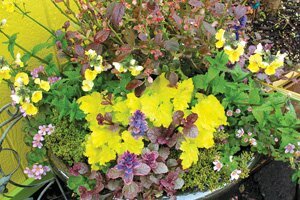
Herbs like lemon thyme and chamomile add interesting foliage interest and texture. Contributed
A number of edibles that are highly ornamental also create horticultural drama. By adding some of your favorite ornamental annuals or perennials to your container designs, you can have the best of all worlds in one square-footage-challenged garden.
If you decide you want to grow tomatoes in containers this season, try under planting your tomato with trailing million bells or calibrichoa and sweet potato vine. The only limit to what you can grow with edibles is your imagination.
